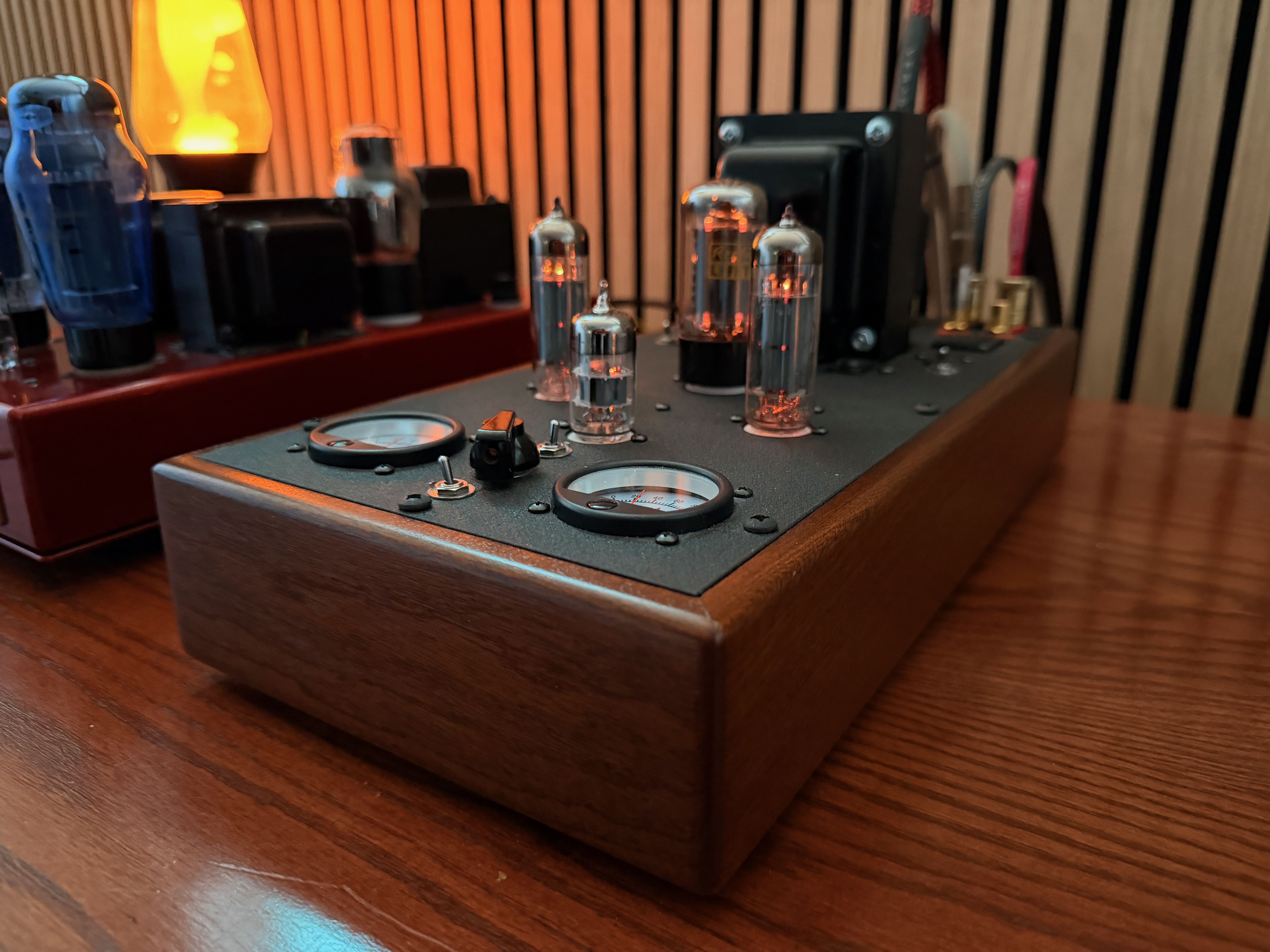
A few weeks ago, my audio friend John—the same generous soul who sold me my Dennis Had Inspire IFA-1—offered to send me a Decware SE84UFO2.1 as a loaner. His pitch was simple: “This will introduce you to the Decware sound that made it famous.” He was curious how it would pair with my DeVore O/96es. So was I. How could I refuse?
The timing was either perfect or slightly cruel, depending on how you look at it. I had just placed my deposit on a Decware Sarah 300B—order number 10116, somewhere behind two thousand other eager souls on a waitlist that stretches over three years into the future. The Zen Triode, John noted, would arrive well ahead of my Sarah. He wasn’t wrong.
Arrival
The amp showed up at noon last Monday. John, being the kind of guy he is, didn’t just send the amplifier. He sent a tube set that reads like a vintage audio shopping list:
- A Mullard/Realistic Great Britain 5AR4 rectifier
- A Winged C NOS 5U4G rectifier (made in the USSR — comes in a genuinely cool atomic-era box)
- A vintage Westinghouse 7308 preamp tube
- A pair of vintage 6P15P-EV power tubes
- A set of handcrafted Belden 8402/Switchcraft RCA cables
I let it warm up and chose the Winged C for my first listen. Then I sat down and tried to be patient. Yeah, right.
Build and Presentation
Before I get into what the Zen Triode sounds like, a word about what it looks like. This is a beautiful piece of kit. Next to my Inspire, it feels more solid, more deliberately constructed—like a piece of furniture crafted to last. The tube sockets have zero play when you seat a tube. The switches feel tight. There are two small meters on the faceplate that I found charming but mysterious (the manual, written obviously and endearingly by Steve Deckert himself, is long on philosophy and short on operational specifics—but that’s OK: he makes up for it with his YouTube vids).
The amp costs under $1,500 new, which is frankly maybe the best value in hifi given what it does. Of course, the true cost is measured in years, not dollars.
First Listen
I started with Maya Delilah’s “Begin Again,” one of my go-to test tracks for new gear. Her voice came forward with an intimacy I wasn’t quite prepared for, while the drum kit moved back and settled into the soundstage with unusual precision. At one point, the drummer hit a splash cymbal I had genuinely never noticed before. No kidding.
Then I put on Kind of Blue.
The soundstage was immense. Bill Evans’ piano materialized stage-left and recessed, with a presence that felt almost architectural—you could feel the geometry of the room. Paul Chambers’ bass had layers of texture I’d heard suggested before but never as fully resolved; I caught sounds in his playing that were new to me. The splash cymbal that announces Davis’ solo lingered in the air the way it must have in the studio. Trane and Cannonball were distinct and occupying their own space—and I found myself drawn more to Adderley’s brightness and forward energy, which confirmed a suspicion I’ve been nursing for a while. I’m still on my jazz journey; still working my way up to an appreciation of Trane.
As the listening session continued, the amp just opened up. The EL84 tubes in triode mode are something I had no experience with before this, and they’re a revelation: compact, glowing with that lovely amber light, and apparently capable of things their modest size shouldn’t allow. John has tried multiple EL84 variants and says none of them compare to these Russian 6P15P-EVs. I’m inclined to take his word for it.
The Decware Sound
I’ve now spent several days with this amp, and I’ve tried to identify exactly what “the Decware sound” means—that quality that apparently caused thousands of people to join a multi-year waiting list after a run of YouTube reviews during COVID.
The word that keeps coming to me is presence.
What the Zen Triode does, at its best, is disappear. The noise floor is exceptionally low. The signal path is short. Voices and acoustic instruments materialize with a three-dimensional solidity that I’ve found genuinely difficult to achieve at any price point. The EL84 in triode is faster and leaner than the Inspire—less rounded in the bass, more immediate and lit-up in the upper midrange. Some listeners, I imagine, might find it slightly forward. I find it revelatory.
The bass deserves special mention. I haven’t connected my subwoofer since the Zen arrived, and I haven’t missed it. The low end on Pino Paladino and Blake Mills’ “Djurkel” is deep and present without being exaggerated—subtle the way bass is supposed to be subtle. It made me wonder, seriously, whether I actually need the sub. Meanwhile, the soundstage on The Buena Vista Social Club can only be described as cavernous. I’ve heard this album dozens of times; it sounded new through the Zen.
One quality I want to linger on: the rendering of fine transient detail. The splash of a cymbal, the slap of a double bass string against the fretboard, the breathy reed of a tenor saxophone—these textures are present and vivid in a way that rewards close listening. You hear into the music, not just at it.
Against the Inspire: A Comparison
After several straight days with the Zen, I put the Dennis Had Inspire back in the chain for a session of deliberate comparison listening, using my usual tube complement—the Sophia EL34s, a Tungsram 7308 pre, and the Wizard Globe 280 rectifier. The differences are real, and they’re not subtle—but let me say upfront that returning to the Inspire was not a disappointment. This is not the experience of going back to a lesser thing. It’s more like switching between two very good painters with different sensibilities.
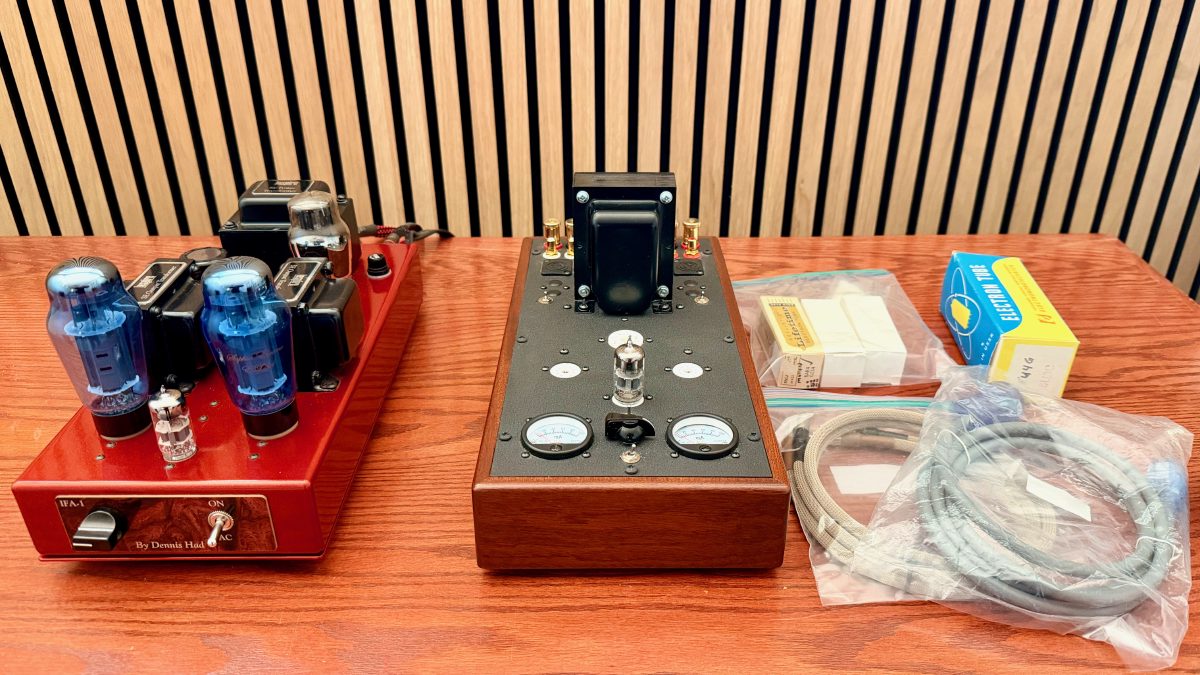
The Inspire’s presentation is fuller, warmer, and a bit more rounded. If the Zen’s soundstage is Hopperesque—precise edges, clear light, figures occupying specific space—then the Inspire’s is more impressionistic: you’re looking at the same scene through slightly softer focus, painted with a heavier brush. “El carretero” off The Buena Vista Social Club felt denser and more enveloping, the bass thicker in a way that some listeners would find more comfortable.
Victory Boyd’s voice on “Open Your Eyes” was present and forward on both amps, but on the Inspire the tube character tends toward a pleasing homogeneity—the performers are rendered coherently, beautifully, but with less of that individuation, that sense of distinct bodies in distinct places, that the Zen pulls off so easily.
The Inspire smooths transients slightly—rounds off the leading edge of a saxophone reed, softens the attack of a cymbal. It does this tastefully, in a way that can feel like musicality rather than coloration. But once you’ve heard the Zen’s rendering of Manu Katché’s “Urban Shadow”—the precise buzz of reed, the sense of a specific instrument in a specific room—it’s hard not to notice the difference.
Does the Zen “win”? I’m not sure that’s the right frame. I think I prefer the Decware’s neutrality and holographic presentation—but the Inspire has not been ruined for me, thank goodness. This isn’t a night-and-day gap like the one I heard when I went from the Rogue Cronus Magnum III to the Audio Research I/50. Both of these are genuinely good amplifiers playing to different strengths.
Where This Leaves Me
I ordered the Alan Eaton 45 monoblocks last month—hand-built pieces arriving in early April—and the conventional wisdom is that a 45 will sound warmer and more organic than the EL84: where the Zen is nimble, airy, and quick, the 45 is supposed to feel textural, corporeal, almost earthbound. I’m curious how my ears will respond. And somewhere in the three-year future, there’s a Decware Sarah with my name on it, a 300B design that may well combine what I love about both of these amps.
For now, though, I’m not in a hurry. The Zen Triode has given me something I wasn’t entirely expecting: not just an excellent amp, but a listening experience that has made familiar music feel genuinely new. I’ve been tearing through my library looking for things to put through it. If that’s not a recommendation, I don’t know what is.
It’s going to be tough to send it back to John in April.