
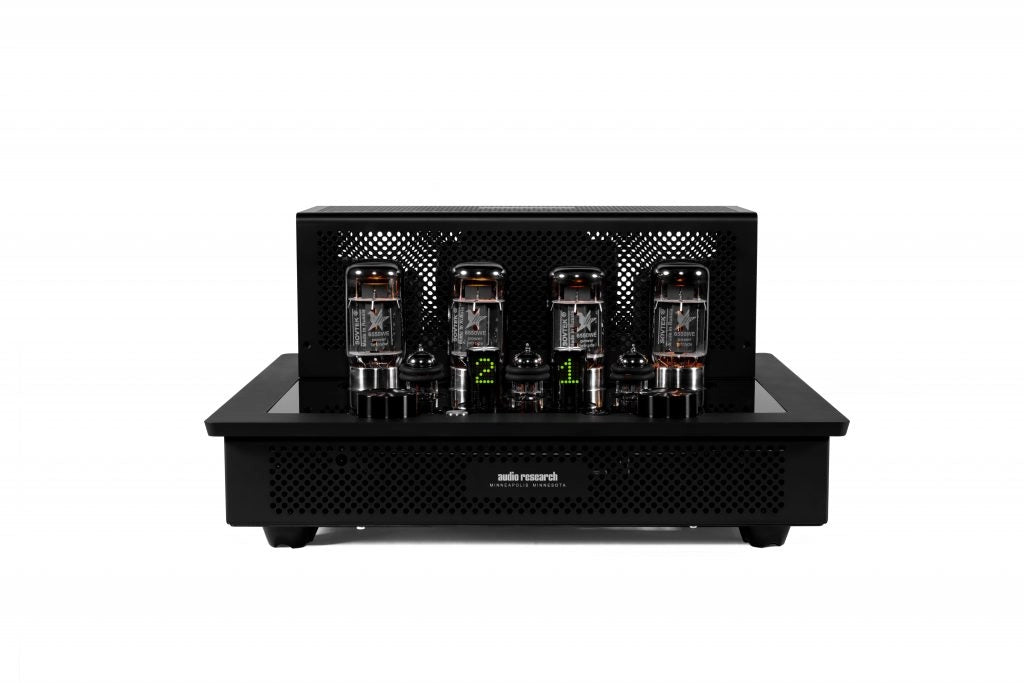
I’ve spent enough years listening to music through compromised systems—cheap headphones, boosted EQ curves, gear that begged for attention—that I know how deeply untrustworthy sound reproduction can be. It trains you to listen for artifacts rather than relationships, for spectacle rather than coherence. Good hi-fi, when it finally arrives, doesn’t announce itself with fireworks. It does something more disarming: it steps aside.
That, more than any single sonic trait, has been my overwhelming initial impression of the Audio Research I/50. This is an amplifier that trusts the music—and, crucially, trusts the listener.
My reference integrated amplifier has been the Rogue Audio Cronus Magnum III, almost always run in triode mode. I know that amp intimately. I admire it. It has power, warmth, scale, and a kind of American confidence that makes brass hit hard and drums feel corporeal. I’ve written before about its ability to deliver that “oh, yeah” moment—where turning the volume up doesn’t feel louder so much as more correct, where dynamics lock into place and music suddenly feels physically present.
The I/50 enters that familiar landscape not as a challenger throwing punches, but as a different philosophy altogether.
Neutrality as an Act of Restraint
The first thing that struck me was neutrality—not the sterile, bleached neutrality that audiophiles sometimes mistake for accuracy, but a calmer, more disciplined presentation. Compared directly to the CMIII, the I/50 is less warm. There’s no denying that. The Rogue wraps the midrange in a gentle harmonic glow; vocals can feel slightly burnished, instruments slightly thickened. The ARC, by contrast, refuses that softening gesture.
At first, this registers as a mild loss. Warmth is comforting. But after a few hours of listening, it becomes clear that what the I/50 is doing instead is redistributing attention. Nothing is being sweetened to pull you in. Nothing is being pushed forward to impress. The music is simply allowed to arrange itself.
That restraint is the beginning of trust.
Separation Without Spotlighting
What I keep returning to is separation—not the etched, hyper-separated presentation that makes every instrument feel isolated under a microscope, but something subtler. Each performer occupies a distinct space. Instruments are not jumbled together; they coexist. A rhythm guitar sits front-right and stays there. A ride cymbal hangs in the air, its decay lingering naturally rather than sparkling for effect. A rim shot registers as a physical gesture, not a treble accent.
This is detail you notice only when your attention drifts toward it. You don’t have to hunt for information; it’s already there. You can decide, almost experimentally, to follow the bass line, or to listen for the drummer’s touch, or to focus on the harmonic interplay between piano and horn—and in every case, the system responds immediately. Nothing is hidden. Nothing is thrust forward.
The Cronus Magnum III does some of this as well—it is far more honest than the consumer gear many of us grew up with—but the I/50 does it with greater ease. The stage feels calmer, darker, and more stable. Silence becomes a pedestal rather than a void, and that silence gives shape to everything else.
Punch Without Brute Force
What surprised me most was how punchy the I/50 sounds. On paper, this shouldn’t be the case. The CMIII has more power, especially with KT120s, and in ultralinear mode it can shove air around with authority. Even in triode, it has a physicality that I associate with scale.
Yet the ARC delivers dynamics differently. Its punch comes from contrast rather than mass. Transients arrive cleanly, decisively, and then get out of the way. Bass notes are not necessarily heavier, but they are better articulated. Drums don’t sound bigger; they sound more intentional. The effect is that dynamics feel faster and more convincing, even at lower listening levels.
This changes how I use the volume control. With the CMIII, I often turn things up to find that magical alignment point where vocals reach their proper physical size and the whole presentation snaps into proportion. With the I/50, that alignment arrives earlier. Presence emerges without coercion. Loudness becomes less of a tool and more of a choice. It sounds good at both low and high volumes.
The Question of Warmth
If I have a reservation—and I do—it’s that the I/50 may ultimately be a touch cooler than my ideal. The Rogue’s warmth, especially in triode, has an undeniable appeal. It flatters voices. It gives brass a little extra burnish. The ARC is less forgiving, less romantic.
That said, I’m conscious that the I/50 is brand new in my system, with new preamp tubes still settling in. Audio Research gear is known to relax slightly over time, particularly in midrange texture. Whether that will materially change my impression remains to be seen. What I do know is that the neutrality I’m hearing now doesn’t feel clinical. It feels deliberate.
Center Image and the Cost of Honesty
I have noticed that on some recordings, the center image feels slightly shifted to the right. This may well be my room—listening position, asymmetrical furnishings, curtains—or it may be the recordings themselves. What’s important is that the I/50 makes such asymmetries audible. Where other amplifiers politely smooth over imbalance, the ARC refuses to editorialize.
That, again, is trust. The amp isn’t correcting the record. It’s presenting it.
From Hi-Fi to Believability
Growing up with Walkmen and cheap headphones, many of us were conditioned to equate excitement with emphasis: boosted highs, pumped bass, a smile-curve that carved music into parts. Good amplification dismantles that training. When nothing is being exaggerated, music stops sounding spectacular and starts sounding coherent.
That’s the shift I’m experiencing with the I/50. Music sounds more harmonized, more organic—not because it’s been smoothed over, but because its internal relationships are intact. Instruments don’t compete for attention; they relate to one another. The amp isn’t telling me what to hear. It’s trusting me to listen.
At this early stage, I can say without hesitation that the Audio Research I/50 is superior to my reference Cronus Magnum III in nearly every way that matters to me: clarity without harshness, detail without insistence, dynamics without force, neutrality without sterility. The Rogue remains a powerful, musically engaging amplifier, and its warmth and shove still have their appeal. But the I/50 feels like a step toward something deeper.
Not better sound, exactly—but more believable sound.
And once you start hearing that, it’s hard to want anything else.