I am not a reviewer. I don’t listen with a clipboard, and I don’t keep score. I live with things. I let them reveal themselves slowly, sometimes over weeks, sometimes over long nights where the only decision left to make is whether to flip the record or let the silence sit for a moment.
In that sense, the Rogue Cronus Magnum III has been one of the most important components I’ve ever owned—not because it was flawless, or revelatory, or transformative in the usual audiophile sense, but because it arrived at exactly the right moment and did exactly what I needed it to do.
It was only the second tube amplifier I ever owned. The first was a Jolida JD302BRC, which taught me that music through glass felt different, slower in a good way, more human. But the Rogue marked my real return to the hobby. This time, I wasn’t dabbling. I was building a room, for goodness’ sake. I was committing to listening as a practice, not a distraction. My kind of cross-legged mindfulness.
I had also made a quiet rule for myself, one that mattered more than specs or buzz: from here on out, I would buy from small American companies. The more bespoke the equipment, the better. Not as a political gesture, not as nostalgia, but as an acknowledgment of techne—of people who build things because they care about how they work and how they’re used. Artists and aficionados, in dialogue. Music as the medium.
The Cronus Magnum III fit that rule perfectly.
I bought it to power a pair of Sonus Faber Sonetto II speakers, and for a while, that combination carried me through rediscovery. All of my early listening happened at Giles’ house, where we swapped cables, flipped impedance taps, pulled the bottom plate just to look inside. Four ohms for the Sonettos. Later, back to eight for the DeVore O/96. Easy. Sensible. Built to be handled.
That mattered to me more than I realized at the time.
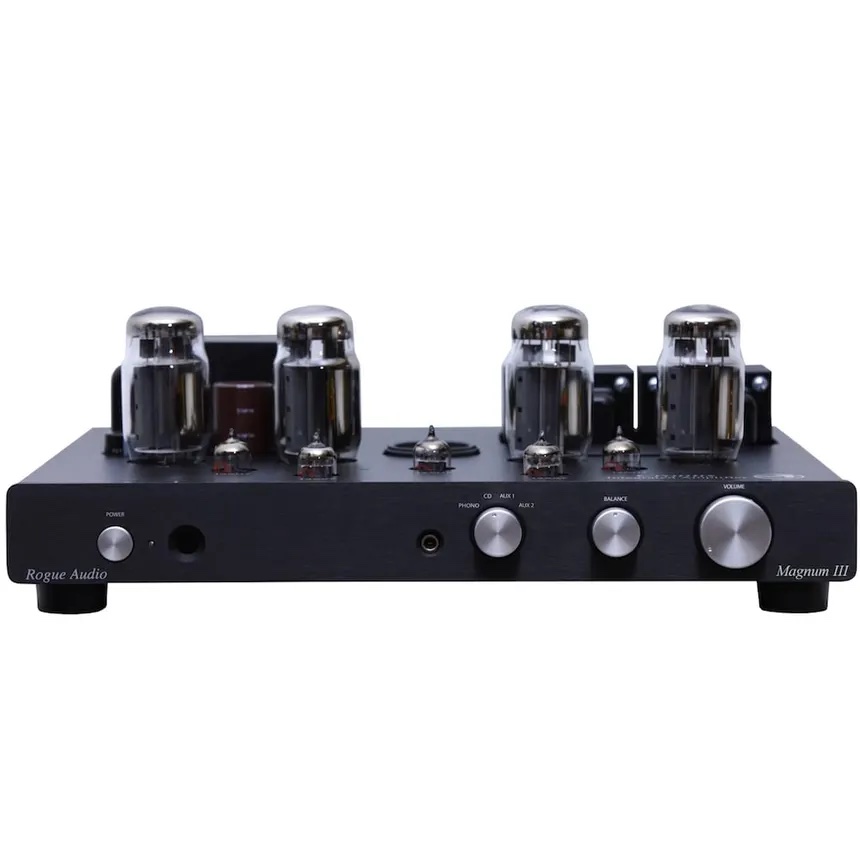
The Rogue looks the way it sounds. It sits low and wide, heavy and confident, like it’s ready to take whatever you throw at it, little tubes poking up like soliders in a trench. Ballsy. Defiant. Manual biasing, but done so intelligently that it never feels like a chore. User-serviceable. Practical. Honest. The kind of amp that assumes you’re an adult and treats you accordingly.
And the sound? I never had a problem with it. Not once.
The soundstage was good. Separation was good. Dynamics were good. There was grunt when the music called for it and air when it didn’t. Detail without fuss. Subtlety without strain. I spent many late nights delighting in what the CMIII would serve me next, because it never insisted on being the star of the show. It played everything pretty well, which turns out to be a rare and undervalued skill.
More than anything, the Cronus was flexible. Not just electrically, but temperamentally. Rock, jazz, folk, electronic—it didn’t flinch. It didn’t demand that I already know what kind of listener I was in the 2020s. In fact, it helped me figure that out. I played a little of everything, not because I was testing the amp, but because I was testing myself.
This is the part that matters most to me now: I could have happily listened to that amplifier for the rest of my life. Truly. There was no dissatisfaction driving me forward, no itch that needed scratching. I had a hell of an amp that I’d picked up for just over three thousand dollars, and I was done.
Until I wasn’t.
Borrowing Giles’ Audio Research I/50 didn’t expose a flaw in the Rogue so much as open a different door. It acted as a catalyst, not a critique. It showed me another way of organizing sound—another lens, to use a word I’ve come to rely on in several contexts. That eventually led me toward single-ended designs, toward immediacy and presence, toward the Dennis Had Inspire amp now on its way to me.
But none of that invalidates the Cronus Magnum III. Quite the opposite. It gave me the stability and confidence to recognize those differences without anxiety. It taught me what “enough” felt like. It let me listen without urgency.
Living with a piece of gear long enough to trust it also means noticing its edges. In the case of the Cronus Magnum III, those edges are real but modest—and worth naming.
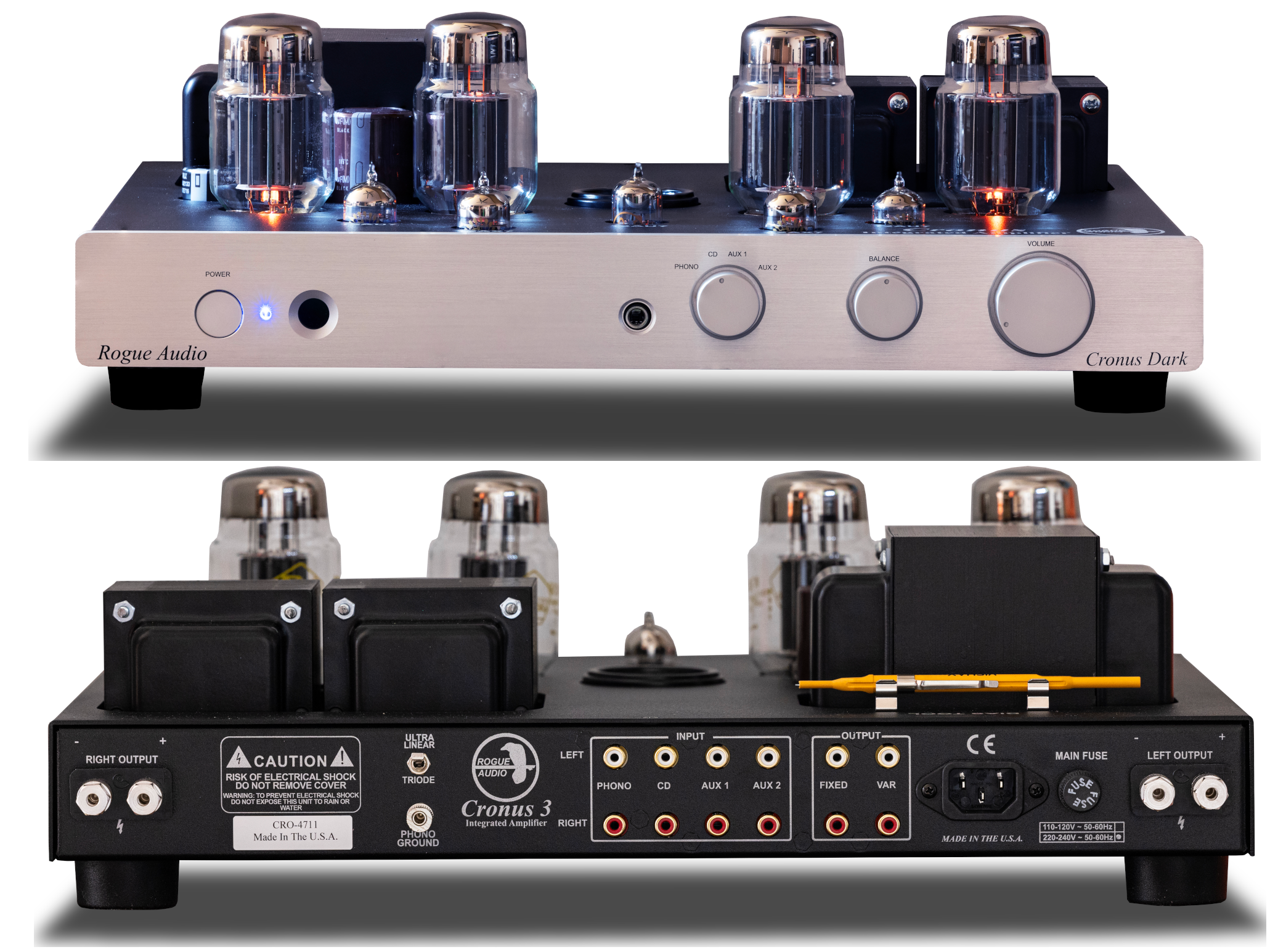
First, switching speaker impedance requires opening the amplifier. This is not a problem if you run a single pair of speakers and leave things alone. In that scenario, you do it once and forget about it. But if you’re someone who rotates speakers regularly, or who keeps multiple pairs with different impedance on hand, this design choice adds friction. The CMIII rewards commitment more than experimentation.
Second, the rear-panel ergonomics could be clearer. The speaker terminals are labeled for polarity, but the markings are small enough that you’ll be leaning in and squinting unless your eyesight is exceptional. A more obvious visual cue—color coding, bolder labeling—would have gone a long way. The placement of the terminals on opposite sides of the rear panel is also a bit awkward, especially if you’re running a subwoofer connection. My sub cable stretched to reach, and it’s worth noting that there is no dedicated sub output.
Finally, there are no balanced inputs or outputs. For many systems, including mine, this was never a functional problem. But in a world where balanced connections are increasingly common, their absence is something prospective owners should be aware of.
That’s really the list.
None of these issues diminish what the Cronus Magnum III is: a fabulously built, musically satisfying, mid-tier tube integrated that does almost everything well and very little wrong. These aren’t deal-breakers. They’re reminders that this amp was designed with a particular listener in mind—someone who values solidity, serviceability, and musical confidence over feature maximalism.
And for the year I lived with it, that listener was me. If I part with it now, it’s not because it failed me. It’s because it succeeded. Its work in my system is complete, though it never did bring me to the Dark side. I won’t say I wasn’t tempted.
There’s a temptation in this hobby to narrate progress as replacement: old thing out, new thing in, hierarchy preserved. That story doesn’t fit here. The Rogue didn’t get displaced; it got contextualized. It remains one of the most solid, capable, and humane amplifiers I’ve ever lived with, and I was proud to own it.
If this reads like a goodbye, it’s meant as a grateful one. The Cronus Magnum III wasn’t just an amplifier in my system. It was a companion during a return—to listening, to patience, to the idea that music deserves attention.
That’s not something I’ll forget. Some part of me has always been and will always be a rogue.