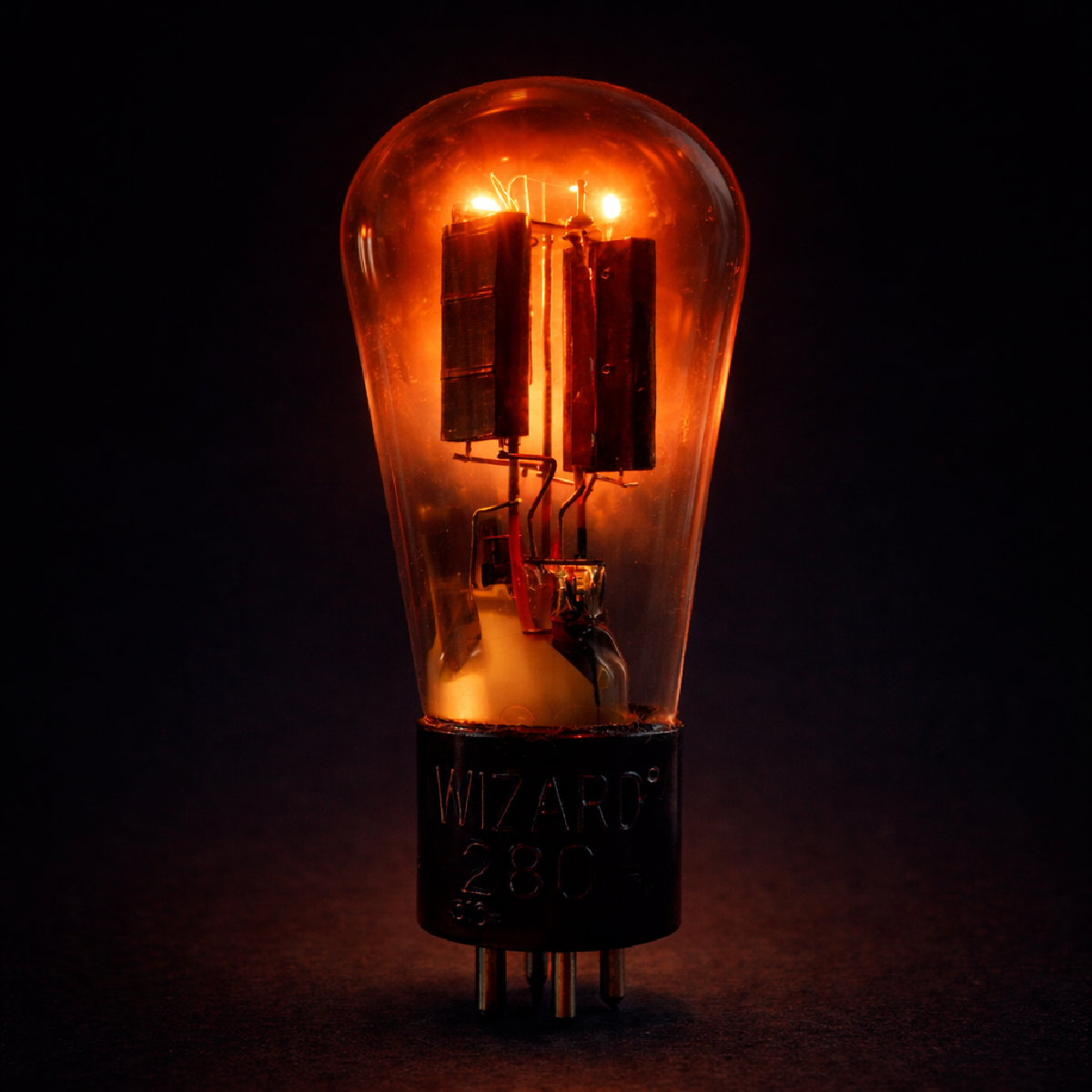
The rectifier now installed in the Inspire SET amplifier is an object older than nearly all the music it mediates. A Wizard globe 280, manufactured in the late 1920s: it predates long-playing records, magnetic tape, stereo reproduction, and the institutionalization of high fidelity itself. It was designed not for music, but for radio power supplies, in an era when broadcasting was still a novelty and domestic electricity unreliable.
Its form announces that history immediately. The globe envelope, swollen and symmetrical, belongs to the earliest generation of vacuum-tube construction, before the straight-sided ST shape became standard and before manufacturers began to hide internal geometry behind industrial regularity. The filament hangs visibly within, its structure legible, its glow unshielded. In the engineering literature of the period, such tubes are described not as components but as devices, transitional objects between laboratory apparatus and domestic machine (cf. Terman, Radio Engineering).
Rectifiers are rarely discussed in audiophile writing except as rolling variables or as agents of vaguely defined “speed” and “liquidity.” In fact, their function is conceptually simple. They convert alternating current into direct current, shaping the power supply that feeds every subsequent stage of amplification. Yet that simplicity conceals an outsized influence. As Langford-Smith observes in the Radiotron Designer’s Handbook, the behavior of the rectifier determines not only voltage but the dynamic regulation of the supply itself: how quickly stored energy is replenished, how much sag occurs under load, and how ripple and recovery shape the operating conditions of every downstream tube.
In early radio engineering, the type 80 family, including the 280, marked a decisive moment in domestic electrification. Prior to their adoption, power supplies relied on mechanical rectifiers, mercury vapor devices, or dangerously improvised arrangements. The 80 introduced a reliable, self-contained method for high-voltage rectification suitable for consumer receivers (RCA, Receiving Tube Manual). It helped make continuous broadcasting possible. In that sense, the Wizard 280 belongs to the infrastructure of mass communication rather than to the genealogy of hi-fi.
So consequently, this tube was built for speech, news, and orchestral broadcasts transmitted through narrow bandwidth and monophonic speakers. It was never intended to shape the reproduction of postwar jazz, magnetic-tape transfers, or high-resolution digital files. And yet it now occupies precisely that role, standing at the electrical threshold of a modern single-ended triode amplifier, regulating the energy that animates recordings made decades after its manufacture.
Installed in the Inspire SET, the 280 produces a supply character that is immediately perceptible. Compared with later rectifiers, recovery is slower, voltage sag more pronounced under transient demand, and the replenishment of stored energy subtly delayed. The audible result is not softness but elasticity. Attacks are fractionally rounded. Decays linger. Microdynamic transitions acquire a faint temporal cushion, as if the amplifier were negotiating between stored charge and musical demand rather than enforcing rigid discipline upon the signal.
On Grant Green’s “Idle Moments,” the opening vamp unfolds with a slightly extended sense of temporal space. Joe Henderson’s tenor enters not with softened articulation but with continuity, the leading edges of notes integrated into the harmonic field rather than detached from it. Cymbal decay extends not in amplitude but in duration, allowing the room captured on tape to remain audible between phrases. These effects are subtle. They are also not mystical. They arise from internal resistance, regulation characteristics, and recovery behavior, precisely the parameters described in classical power-supply theory (Langford-Smith; Terman).
What gives the Wizard 280 its peculiar authority, however, is not merely its sonic contribution but its temporal position. It belongs to a pre-recorded era. It predates jazz as a recorded art form. It predates electrical guitar. It predates the idea that sound might be preserved, replayed, and compared.
And yet here it stands, nearly a century later, mediating digital playback stored on solid-state memory, transmitted across fiber networks, and decoded by contemporary converters. In Jonathan Sterne’s account of sound reproduction, modern listening is always the product of layered mediations, each technological regime leaving residues within the next (The Audible Past). The Wizard 280 embodies that layering materially. It belongs simultaneously to early radio culture and to contemporary high-resolution playback.
In Walter Benjamin’s terms, this object possesses auraAuraWalter Benjamin's term for the unique presence of a work or object in time and place, tied to history, distance, and unrepeatable context. not through rarity alone but through survival. It has outlived its original function and acquired new mediation without losing its historical inscription. It is not nostalgia restored. It is history still working. As Igor Kopytoff argues, objects acquire biographies as they move through social contexts, accumulating meanings not present at their manufacture. The Wizard 280 now carries two lives: one in radio infrastructure, another in domestic listening.
There is also a quieter implication. Power supplies are usually treated as neutral infrastructure, subordinate to signal tubes and output devices. The 280 complicates that hierarchy. It reminds us that musical interpretation begins not at the grid of the input tube but at the wall socket, at the conversion of alternating current into something stable enough to permit sound at all. Before tone, before timbre, before space, there is rectification.
Listening through this tube, one becomes acutely aware that reproduction is not merely translation but negotiation. The amplifier does not simply pass the signal forward. It continuously arbitrates between stored energy and musical demand, between early engineering assumptions and present listening expectations.
That this arbitration is performed by a device built before high fidelity existed at all is not irony. It is continuity.
The Wizard globe 280 does not add romance to the system. It adds history. And in doing so, it reminds the listener that every act of reproduction is also an act of inheritance.
Technical and Historical Notes
- Tube type: 280 (direct-heated full-wave rectifier)
- Era: Late 1920s to early 1930s
- Base: Four-pin UX
- Typical use: Radio power supplies, early receivers
- Electrical lineage: Type 80 family
References
- Benjamin, Walter. “The Work of Art in the Age of Mechanical Reproduction.” In Illuminations. New York: Schocken, 1968.
- Eisenberg, Evan. The Recording Angel: Music, Records, and Culture from Aristotle to Zappa. New Haven: Yale University Press, 1987.
- Kopytoff, Igor. “The Cultural Biography of Things.” In The Social Life of Things, edited by Arjun Appadurai. Cambridge: Cambridge University Press, 1986.
- Langford-Smith, F. (ed.). Radiotron Designer’s Handbook, 4th ed. Sydney: Wireless Press, 1953.
- RCA. Receiving Tube Manual, RC-14. Harrison, NJ: RCA, 1940.
- Sterne, Jonathan. The Audible Past: Cultural Origins of Sound Reproduction. Durham: Duke University Press, 2003.
- Terman, Frederick E. Radio Engineering. New York: McGraw-Hill, 1937.