I can’t listen to Aqualung without also hearing the echo of my late-80s, early-90s self in Cincinnati—the kid (and I mean kid) who was deep into his Jethro Tull phase, swapping discs in and out of the his Adcom gear like it was a religious rite. My girlfriend Darlene had these black Profile speakers she’d fallen in love with after hearing them in Sarasota—I’m pretty sure she heard them at Mario’s Audio Workshop during our trip there in 1990—and they were the other half of the equation. Ian Anderson’s voice and flute came alive through them, even if the recording never quite gave the band the space I thought it deserved.
My current copy is the 24/96 UHQR pressing, and it’s the best I’ve ever heard this record sound—generous, open, with a consistent soundstage that feels almost like a live performance. UHQR, for the uninitiated, stands for “Ultra High Quality Record,” a boutique format designed for obsessive ears, pressed on heavy vinyl with meticulous mastering. It’s overkill for some, but for Aqualung, it’s like dusting off a painting you’ve only ever seen behind glass. Someone ripped my copy of Aqualung UHQR and did a great job; my thanks to them.
When Aqualung landed in 1971, it was a pivot point—not just for Tull, but for rock itself. The psychedelic optimism of the ’60s had curdled; Vietnam was grinding on, Britain was in economic malaise, and the counterculture had lost its halo. British bands that had cut their teeth on blues—Tull included—were branching out, mixing hard rock’s grit with folk’s intimacy and, in Anderson’s case, a Renaissance-madrigal sense of melody. Aqualung is all three at once, and improbably, it works.
The opener, “Aqualung,” is Tull’s calling card—part character study, part social critique, and part suite. The lecherous street-dweller at its center is no saint, but Anderson paints him with enough human detail that you wonder if he’s a victim as much as a villain. The hard-rock opening riff is Martin Barre in full force, and the shift to the acoustic middle section is pure Tull—that moment when the bombast drops and Anderson’s acoustic guitar feels like the truer voice of the band.
“Cross-Eyed Mary” lives in the same world as Aqualung, but from the playground’s edge. She’s a schoolgirl prostitute who prefers her clients “letching grey,” but there’s a twist of charity in the way she steals from her johns to help others. It’s bawdy, biting, and a little absurd—Anderson’s smirk audible in every verse.
Then comes a run of short acoustic pieces—“Cheap Day Return,” “Mother Goose,” “Wond’ring Aloud,” “Slipstream”—that are, for me, the heart of the record. “Cheap Day Return” is a 60-second postcard from a nursing home visit, written after Anderson saw his father in hospital; the nurse asking for his autograph adds an almost absurd detachment. “Mother Goose” is a surreal tour through a mythical London, half fairy tale, half street-corner observation. “Wond’ring Aloud” is tender, domestic—a moment of new-love contemplation that finds its wisdom in the final couplet, which may be the album’s moral: “And it’s only the giving / That makes you what you are.” Even “Slipstream,” brief as it is, plays like a lyrical footnote, extending the album’s anti-religious undercurrent.
“My God” makes that undercurrent explicit. Anderson rails against organized religion, against the way people hide behind their gods to excuse cruelty. It builds into a remarkable flute-and-choir section, as if Anderson wanted to steal the church’s own tools to dismantle it. “Hymn 43” follows with a sneer—rock ’n’ roll blasphemy at its most concise: “If Jesus saves, he better save himself.”
“Locomotive Breath” has never been my favorite, but on the UHQR it has new life: the atmospheric piano intro shimmering, the rhythm section tightening into a slow-build groove before the train starts barreling forward. Anderson has said it’s about the unstoppable forces of capitalism and overpopulation, and once you hear it that way, the urgency makes more sense. Even if we wanted to at this point, how could we slow down?
The closer, “Wind-Up,” ties the album’s threads together: a rejection of blind faith in favor of personal truth. “I’d rather look around me, compose a better song,” Anderson sings, and that’s the thesis: don’t take the hand-me-down worldview; write your own music.
As much as Aqualung is remembered for its big riffs and iconic title track, I’ve always thought it’s Anderson’s quieter, more intricate writing that makes it endure. Tull could do the blues-rock thing as well as any of their peers, but Aqualung shows they could also craft something stranger and more lasting—an album that’s as much about the space between the notes as the notes themselves.
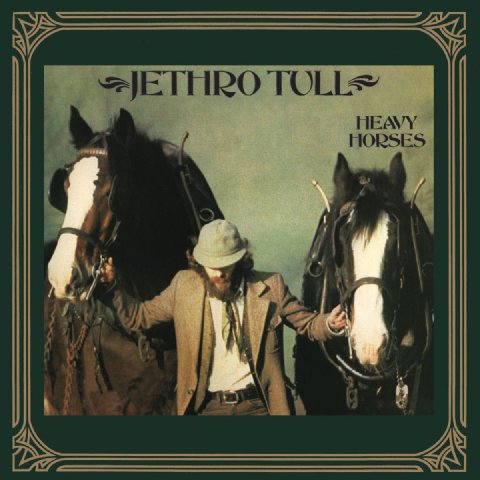
And that’s probably why, even though it’s not my favorite Tull record (that would be Heavy Horses, Darlene’s pick), it still spent a lot of time in my CD player back in Cincinnati. It’s the rare album that can sit comfortably between hard rock muscle, folk delicacy, and madrigal whimsy and sound utterly like itself.