After I returned John’s SE84UFO2.1, I had a problem. I’d spent three weeks with what might be the best amplifier I’ve ever heard, and now it was gone. I had the Alan Eaton 45 monoblocks arriving shortly, so I wasn’t exactly bereft—but the Decware sound had gotten into my head. I’d already ordered a Sarah back in January (order #10116, currently aging like wine somewhere in East Peoria), but that’s three-plus years away. What was I supposed to do in the meantime?
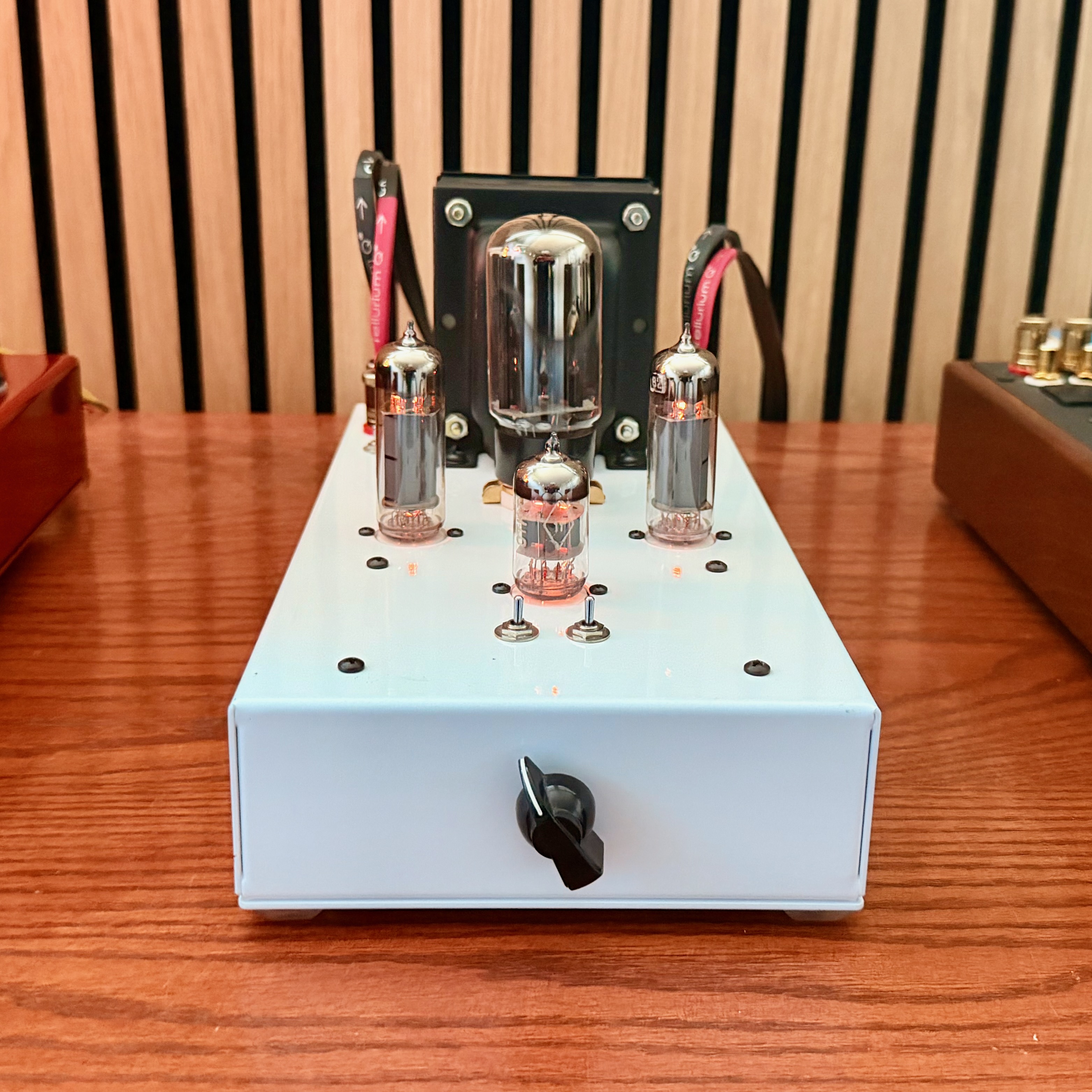
The answer arrived on US Audio Mart: a white SE84C+, built in August 2011, listed by a guy named Shep in Acworth, GA—just north of Atlanta, near my brother. Here’s what caught my eye: the amp had developed a hum, and Shep had sent it back to Decware. Steve Deckert personally diagnosed a leaky capacitor, and the amp returned with Poly Bypass capacitors and the 25th Anniversary UFO transformers installed. In other words, it came back from Illinois as something close to the current production model. The scuffs Shep photographed from his ad? Invisible from a listening chair. I made him an offer the same day.
The SE84C+ is a smaller amp than the UFO2.1—noticeably so, sitting next to the Alan Eatons. But the form factor belies nothing about the sound. On first listen, running Feverkin’s Calendar Project through my DeVore O/96s, I kept waiting for the moment it would reveal itself as a lesser machine. That moment never came. The holographic quality I’d fallen for on John’s amp was right there: that dark, low noise floor; instruments placed in space with specificity; voices out front, present without being pushed.
Detail retrieval is exceptional. On David Byrne’s cover of “Drivers License,” I could hear the brittle edge that age has introduced to his voice—not harshness, but texture, the kind of thing that tells you a voice has history. I pulled up his Grown Backwards, an album I’d somehow never given a proper listen, and found myself sitting with it for an hour. Marion Hill. Steely Dan. Natalie Merchant. Paul Simon. Billie Holiday. The amp is indifferent to genre in the best way: it just gets out of the road and lets the music happen.
Shep also handed over four handwritten pages of tube-rolling notes, which is either generous or a form of benign curse, depending on your constitution. I’ve already tried the Wizard Globe 280 rectifier he recommended. The bass trades some weight for more shimmer in the mids and highs—a worthwhile swap on the right recordings. I have more combinations to work through, which is half the fun.
One thing worth noting if you’re considering a vintage SE84 on the used market: the upgrade path exists. If you find a well-maintained pre-UFO unit, Decware will work on it. The Poly Bypass caps and anniversary transformers make a meaningful difference, and getting them from the source—with Steve Deckert’s hands in it—is about the best provenance you can ask for.
I’ve now had time to compare the SE84C+ against the Alan Eaton 45 monoblocks, which arrived shortly after and deserve their own full treatment—coming soon. The short version: the 45s are warmer, more corporeal, with a slightly fuller center image and a different kind of dynamic punch. The SE84C+ is faster, more lit-up in the upper midrange, more airy. What neither amp does is disappoint. But when I want to hear voices—when the music is a singer and a recording and a room and I want all three present in my living room—I reach for the Zen.
John loaned me his UFO2.1 to introduce me to the Decware sound. What it actually did was make the SE84C+ feel inevitable. The loaner left; the sound stayed.
The Decware SE84C+ is no longer in production. The current equivalent is the SE84UFO, available direct from Decware in East Peoria, IL — with a wait time measured in years rather than weeks.