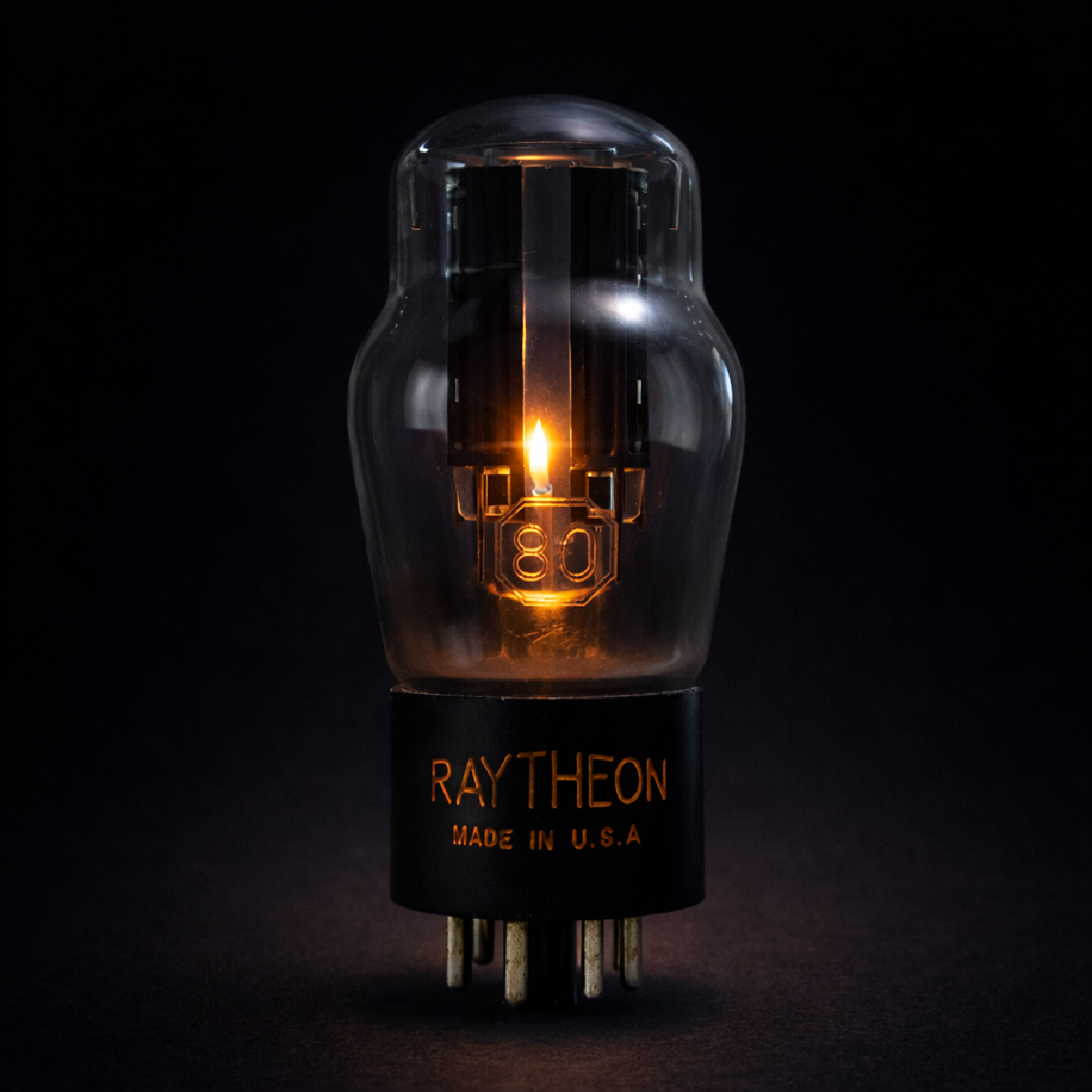
Today, I have a look at a Raytheon-manufactured type 80, produced in the interwar period, when vacuum-tube rectification had become not merely experimental but standardized. Manufactured in the United States during the interwar period, the Raytheon 80 belongs to the moment when American electronics production shifted from artisanal fabrication to full industrial standardization. Unlike the Wizard globe 280, whose identity is bound to the transitional aesthetics of early radio engineering, the 80 belongs to the moment when power conversion had settled into industrial discipline.
The two tubes are closely related. Electrically, the 280 is a direct descendant of the 80 family. Mechanically, the 80 represents its canonical form. Introduced in the mid-1920s, the type 80 was among the first rectifiers to achieve widespread adoption in domestic receivers, establishing a template that would dominate radio power supplies for more than a decade (RCA 43).
Its form announces that standardization immediately. Where the Wizard 280 displays the swollen symmetry of early globe construction, the Raytheon 80 adopts the later ST envelope, narrower at the waist, more compact, more industrial. Internal geometry is more tightly organized. Filament spacing is disciplined. The tube no longer appears as laboratory apparatus. It appears as product.
By the time the 80 became ubiquitous, rectification was no longer an experimental problem. It was an infrastructural one. In Terman’s account, the introduction of reliable full-wave rectifiers “marked the transition from improvised power supplies to standardized high-voltage conversion suitable for continuous service” (431). The 80 is the first rectifier to embody that transition fully.
Functionally, its role is simple and decisive. As a directly heated full-wave rectifier, it converts alternating current into pulsating direct current, feeding the reservoir capacitors and choke network that define the amplifier’s operating stability. This is where the 80 distinguishes itself from the 280.
Compared with the Wizard 280, the Raytheon 80 exhibits lower internal resistance, faster conduction recovery, and more stable voltage under transient demand (RCA 44). These are not marginal differences. They shape the amplifier’s temporal discipline.
Installed in the Inspire SET, the Raytheon 80 produces an immediate change in comportment. Compared directly with the Wizard 280, the presentation tightens. Leading edges sharpen. Dynamic contrasts become more explicit. The amplifier no longer breathes with the music. It asserts tempo.
On John Coltrane’s Blue Train, the opening trumpet entrance arrives with greater immediacy. Articulation is firmer. The space between notes contracts slightly, not by compression but by regulation. The ride cymbal’s decay shortens fractionally, its envelope more tightly bounded. Bass lines acquire clearer onset and quicker release. The effect is not brighter, nor more forward. It is more disciplined.
This difference arises precisely from what Langford-Smith describes as rectifier regulation behavior. The 80’s lower voltage drop and faster conduction permit more rapid replenishment of reservoir capacitors, reducing sag during dynamic peaks and stabilizing plate voltage under transient demand (1127). Where the 280 yields, the 80 holds. In listening terms, this becomes clarity.
Comparing the two rectifiers reveals a fundamental distinction between elasticity and control. The Wizard 280 grants time. The Raytheon 80 enforces proportion. Neither is superior. They articulate different philosophies of power. This distinction illuminates a deeper historical shift.
The 280 belongs to early radio culture, when power supplies tolerated fluctuation, when program material was narrow in bandwidth and forgiving in dynamics. The 80 belongs to the stabilization of broadcast culture, when continuous service, higher voltages, and more complex receiver circuits demanded predictability. In this sense, the 80 is the first rectifier designed not merely to function, but to regulate.
Sterne’s account of technological regimes clarifies this transition. New sound technologies do not replace older ones, he argues, but reorganize listening by imposing new norms of stability, clarity, and expectation (22–23). The 80 embodies precisely such a reorganization. It inaugurates a regime in which power becomes disciplined rather than permissive. That discipline persists.
Listening through the Raytheon 80, one becomes aware that temporal behavior is not neutral. The rectifier determines not only voltage but pacing, not only energy but rhetoric. Musical gestures feel more assertive. Rhythmic articulation gains contour. The amplifier acquires what might best be called authority of timing. In Eisenberg’s terms, this is the point at which reproduction ceases to float and begins to govern (76). The power supply no longer adapts itself to the signal. It conditions it.
The cultural biography of the Raytheon 80 deepens this authority. Unlike the Wizard 280, whose manufacture straddles artisanal and industrial regimes, the 80 is a product of full industrial rationalization. Raytheon, by the 1930s, had become a major supplier to both civilian and military electronics, standardizing production, materials, and testing. This tube was not built to survive. It was built to be replaced. That it has survived is therefore more remarkable.
In Kopytoff’s terms, the 80 has crossed multiple biographical thresholds. It has moved from radio receiver to archival artifact to domestic hi-fi component, acquiring meanings that its designers could not have anticipated (Kopytoff 67). Its present authority derives not from rarity but from endurance.
Placed beside the Wizard 280, the Raytheon 80 now reveals the archive’s first explicit dialectic. One rectifier governs time by yielding to it. The other governs time by regulating it.
Listening through both, one hears not merely tonal differences but philosophies of power. If the 280 teaches patience, the 80 teaches discipline. And in that discipline, one hears the birth of modern amplification.
References
- Eisenberg, Evan. The Recording Angel: Music, Records, and Culture from Aristotle to Zappa. New Haven: Yale University Press, 1987.
- Kopytoff, Igor. “The Cultural Biography of Things.” In The Social Life of Things, edited by Arjun Appadurai. Cambridge: Cambridge University Press, 1986.
- Langford-Smith, F. (ed.). Radiotron Designer’s Handbook, 4th ed. Sydney: Wireless Press, 1953.
- RCA. Receiving Tube Manual, RC-14. Harrison, NJ: RCA, 1940.
- Sterne, Jonathan. The Audible Past: Cultural Origins of Sound Reproduction. Durham: Duke University Press, 2003.
- Terman, Frederick E. Radio Engineering. New York: McGraw-Hill, 1937.